
Ethical Hacking - TCP/IP Hijacking

TCP/IP Hijacking is when an authorized user gains access to a genuine network connection of another user. It is done in order to bypass the password authentication which is normally the start of a session.
In theory, a TCP/IP connection is established as shown below −
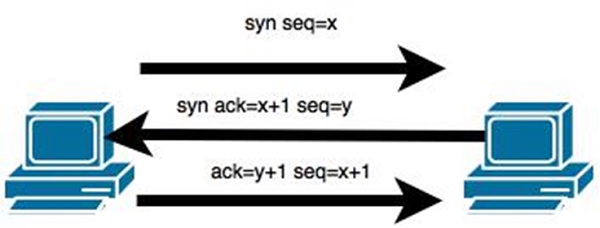
TCP/IP To hijack this connection, there are two possibilities −
  • Find the seq which is a number that increases by 1, but there is no chance to predict it.
  • The second possibility is to use the Man-in-the-Middle attack which, in simple words, is a type of network sniffing. For sniffing, we use tools like Wireshark or Ethercap.

Example

An attacker monitors the data transmission over a network and discovers the IP’s of two devices that participate in a connection.
When the hacker discovers the IP of one of the users, he can put down the connection of the other user by DoS attack and then resume communication by spoofing the IP of the disconnected user.

Shijack

In practice, one of the best TCP/IP hijack tools is Shijack. It is developed using Python language and you can download it from the following link − https://packetstormsecurity.com/sniffers/shijack.tgz
Here is an example of a Shijack command −
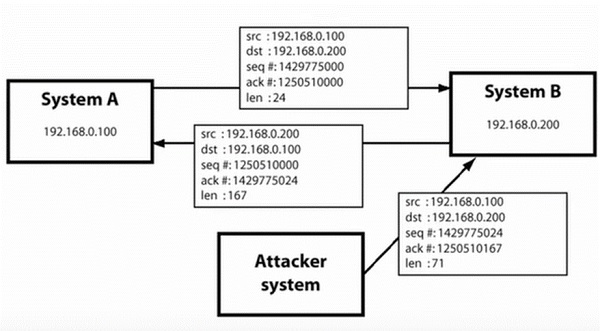
root:/home/root/hijack# ./shijack eth0 192.168.0.100 53517 192.168.0.200 23
Shijack Here, we are trying to hijack a Telnet connection between the two hosts.
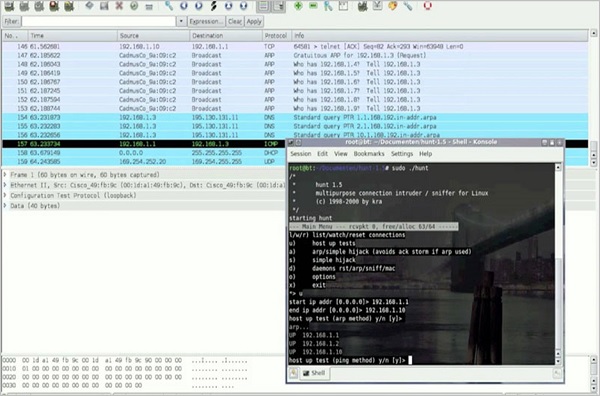
Hunt

Hunt is another popular tool that you can use to hijack a TCP/IP connection. It can be downloaded from − https://packetstormsecurity.com/sniffers/hunt/
Hunt

Quick Tip

All unencrypted sessions are vulnerable to TCP/IP session hijacking, so you should be using encrypted protocols as much as possible. Or, you should use double authentication techniques to keep the session secured.

Comments

Popular posts from this blog

IMPORTANCE AND ADVANTAGES OF SIWES

STUDENTS INDUSTRIAL WORK EXPERIENCE SCHEME (SIWES) The Industrial Training/Students Industrial Work Experience Scheme, IT/SIWES is a new Directorate under the Vice-Chancellor’s Office.  It was established on 20th April, 2012 The Students Industrial Work Experience Scheme (SIWES) is a skills training programme designed to expose and prepare students of universities and other tertiary institutions for the Industrial Work situation they are likely to meet after graduation.  It is also a planned and structured programme based on stated and specific career objectives which are geared towards developing the occupational competencies of participants (Mafe, 2009).  Consequently, the SIWES programme is a compulsory graduation requirement for all Nigerian university students offering certain courses. The Students Industrial Work Experience Scheme (SIWES), is the accepted training pro...

Animal Cell

 By Lasisi Halima Billy   All animal cells are multicellular. They are eukaryotic cells.  A nimal cells  are surrounded by plasma membrane and it contains the nucleus and organel les that are membrane bound. A nimal cells are of various sizes and have irregular shapes.  Most of the cells size range between 1 and 100 micrometers and are visible only with help of microscope.  Trillions of cells are found in the human body.  There are many different types of cells, approximately 210 distinct cell types in adult human body.   Animal Cell Definition    Animal cells are eukarytoic. Animal cells are have outer boundary known as the plasma membrane.  T he nucleus and the organelles of the cell are bound by a membrane.  The genetic material (DNA) in animal cells...

Light Microscope vs Electron Microscope.

Both light microscopes and electron microscopes use radiation (light or electron beams) to form larger and more detailed images of objects (e.g. biological specimens, materials, crystal structures, etc.) than the human eye can produce unaided. (See also: What is eyesight ? ) An electron microscope is a microscope that uses beams of electrons instead of rays of visible light to form highly magnified images of tiny areas materials or biological specimens. Comparing light vs electron microscopes is made more complicated by the fact that there are different types of electron microscopes. The two main types of electron microscope are the Transmission Electron Microscope (TEM) and Scanning Electron Microscope (SEM). Other types of electron microscope include the Scanning Tunneling Microscope (STM) and Field Emission Transmission Microscope (FE-TEM). Brief notes, see the tables lower down this page for figures, explanations and comments: ...