
Ethical Hacking - Skills

As an ethical hacker, you will need to understand various hacking techniques such as −
  • Password guessing and cracking
  • Session hijacking
  • Session spoofing
  • Network traffic sniffing
  • Denial of Service attacks
  • Exploiting buffer overflow vulnerabilities
  • SQL injection
In this chapter, we will discuss some of the skills that you would require to become an expert in Ethical Hacking.

Basic Skills

Computer Hacking is a Science as well as an Art. Like any other expertise, you need to put a lot of effort in order to acquire knowledge and become an expert hacker. Once you are on the track, you would need more effort to keep up-to-date with latest technologies, new vulnerabilities and exploitation techniques.
  • An ethical hacker must be a computer systems expert and needs to have very strong programming and computer networking skills.
  • An ethical hacker needs to have a lot of patience, persistence, and perseverance to try again and again and wait for the required result.
Additionally, an ethical hacker should be smart enough to understand the situation and other users’ mind-set in order to apply social engineering exploits. A good ethical hacker has great problem-solving skills too.

Courses & Certifications

This tutorial provides the basic guidelines to become a successful Ethical Hacker. If you want to excel in this field, then you might choose to pursue the following courses and certifications −
  • Obtain a bachelor’s degree in Computer Science or A+ Certificate to gain an understanding of the most common hardware and software technologies.
  • Get into a programmer’s role for a few years and then switch to get a tech support position.
  • Proceed to get network certifications like Network+ or CCNA and then security certifications like Security+, CISSP, or TICSA.
  • It is recommended that you get some work experience as a Network Engineer and System Administrator to understand networks and systems inside out.
  • Keep going through various books, tutorials and papers to understand various computer security aspects and take them as a challenge to secure your network and computer systems as network security engineer.
  • Study courses which cover creating Trojan horses, backdoors, viruses, and worms, denial of service (DoS) attacks, SQL injection, buffer overflow, session hijacking, and system hacking.
  • Master the art of penetration testing, footprinting and reconnaissance, and social engineering.
  • Finally go for a Certified Ethical Hacker (CEH) Certification.
GIAC (Global Information Assurance Certification) and Offensive Security Certified Professional (OSCP) are additional IT security certifications which will add a lot of value to your profile.

Final Note

You need to stay as a White Hat Hacker which means you need to work within given boundaries. Never intrude or attack any computer or network without a required permission from the authorities.
As a final note, it is highly recommended that you refrain from engaging yourself in black hat hacking which may spoil your entire career.

Ethical Hacking - Process

Like all good projects, ethical hacking too has a set of distinct phases. It helps hackers to make a structured ethical hacking attack.
Different security training manuals explain the process of ethical hacking in different ways, but for me as a Certified Ethical Hacker, the entire process can be categorized into the following six phases.
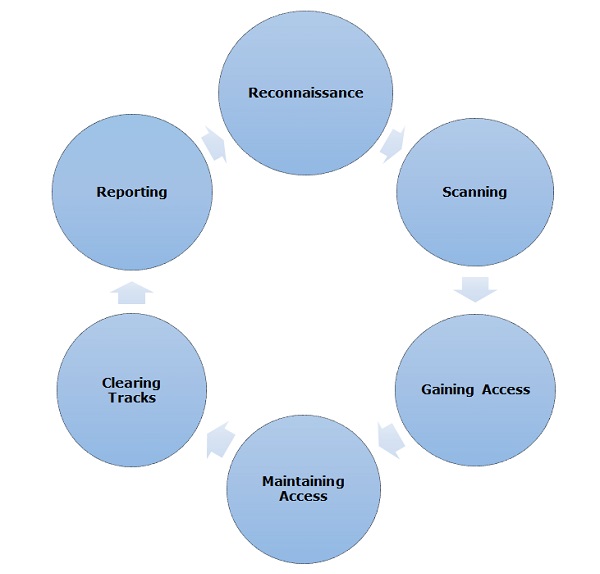
Ethical Hacking Process

Reconnaissance

Reconnaissance is the phase where the attacker gathers information about a target using active or passive means. The tools that are widely used in this process are NMAP, Hping, Maltego, and Google Dorks.

Scanning

In this process, the attacker begins to actively probe a target machine or network for vulnerabilities that can be exploited. The tools used in this process are Nessus, Nexpose, and NMAP.

Gaining Access

In this process, the vulnerability is located and you attempt to exploit it in order to enter into the system. The primary tool that is used in this process is Metasploit.

Maintaining Access

It is the process where the hacker has already gained access into a system. After gaining access, the hacker installs some backdoors in order to enter into the system when he needs access in this owned system in future. Metasploit is the preferred tool in this process.

Clearing Tracks

This process is actually an unethical activity. It has to do with the deletion of logs of all the activities that take place during the hacking process.

Reporting

Reporting is the last step of finishing the ethical hacking process. Here the Ethical Hacker compiles a report with his findings and the job that was done such as the tools used, the success rate, vulnerabilities found, and the exploit processes.

Quick Tip

The processes are not standard. You can adopt a set of different processes and tools according to your techniques that you are comfortable with. The process is of least significance as long as you are able to get the desired results.

Comments

Popular posts from this blog

IMPORTANCE AND ADVANTAGES OF SIWES

STUDENTS INDUSTRIAL WORK EXPERIENCE SCHEME (SIWES) The Industrial Training/Students Industrial Work Experience Scheme, IT/SIWES is a new Directorate under the Vice-Chancellor’s Office.  It was established on 20th April, 2012 The Students Industrial Work Experience Scheme (SIWES) is a skills training programme designed to expose and prepare students of universities and other tertiary institutions for the Industrial Work situation they are likely to meet after graduation.  It is also a planned and structured programme based on stated and specific career objectives which are geared towards developing the occupational competencies of participants (Mafe, 2009).  Consequently, the SIWES programme is a compulsory graduation requirement for all Nigerian university students offering certain courses. The Students Industrial Work Experience Scheme (SIWES), is the accepted training pro...

Animal Cell

 By Lasisi Halima Billy   All animal cells are multicellular. They are eukaryotic cells.  A nimal cells  are surrounded by plasma membrane and it contains the nucleus and organel les that are membrane bound. A nimal cells are of various sizes and have irregular shapes.  Most of the cells size range between 1 and 100 micrometers and are visible only with help of microscope.  Trillions of cells are found in the human body.  There are many different types of cells, approximately 210 distinct cell types in adult human body.   Animal Cell Definition    Animal cells are eukarytoic. Animal cells are have outer boundary known as the plasma membrane.  T he nucleus and the organelles of the cell are bound by a membrane.  The genetic material (DNA) in animal cells...

Light Microscope vs Electron Microscope.

Both light microscopes and electron microscopes use radiation (light or electron beams) to form larger and more detailed images of objects (e.g. biological specimens, materials, crystal structures, etc.) than the human eye can produce unaided. (See also: What is eyesight ? ) An electron microscope is a microscope that uses beams of electrons instead of rays of visible light to form highly magnified images of tiny areas materials or biological specimens. Comparing light vs electron microscopes is made more complicated by the fact that there are different types of electron microscopes. The two main types of electron microscope are the Transmission Electron Microscope (TEM) and Scanning Electron Microscope (SEM). Other types of electron microscope include the Scanning Tunneling Microscope (STM) and Field Emission Transmission Microscope (FE-TEM). Brief notes, see the tables lower down this page for figures, explanations and comments: ...